
FederalClaims.us · Trade War Research Series
Trade War With Canada: Who Decides, Who Pays?
A legal and economic briefing on the 2026 U.S.–Canada tariff escalation, Section 338 of the Tariff Act of 1930, the constitutional allocation of tariff power, and the costs imposed on integrated North American trade.
Executive summary
The episode distinguishes the new 2026 Section 338 measures from earlier tariff actions and asks two questions: who has lawful authority to impose the duties, and who bears their economic cost?
The United States relies on Section 338 of the Tariff Act of 1930 to impose additional duties on selected Canadian goods after findings of discrimination against U.S. commerce. The episode contrasts that delegation with the Supreme Court's February 2026 decision holding that IEEPA did not authorize presidential tariffs.
Economically, the customs duty is collected from the U.S. importer of record. The burden can then be distributed through lower margins, renegotiated prices, canceled orders, supply-chain changes, delayed investment, and higher downstream prices.
The research record preserves both governments' stated positions and links the viewer to the governing statutes, proclamations, treaty text, court decision, and court rules.
Chapter index
Select a chapter to start the video at that point.
Edited publication transcript
Lightly edited for readability and legal/economic precision.
Transcript integrity: YouTube captions preserve the final spoken narration. The text below is the publication edition; it corrects grammar and clarifies several propositions without representing those edits as words spoken in the video.
00:10 · Introduction — the border as the supply chain
00:10For generations, the United States and Canada treated their border as a respected space between neighbors. Energy, grain, lumber, aluminum, cars, machinery, and people crossed those borders every day. Factories on both sides were built around one another, with back-and-forth transit for products and assemblies. Now the trust, stability, and prosperity built by generations is faced with antagonism, betrayal, and economic acts of war. On August 22nd, 2026, that integration became weaponized by yet another exercise of tariff power, when the United States declared additional tariffs of 50 percent against a specified basket of Canadian goods. Canada answered that it would retaliate dollar for dollar beginning September 8th. Its prime minister declared that Canada has been attacked. This is not a shooting war, but one of resilience, love of truth, and awaiting regime change. The United States of America has declared economic war on Canada. Tariff power is being used to compel Canadians to change their laws, purchasing choices, industrial policy, and international relationships. This is not legitimate policy. It sets the low-water mark. We can look forward to rebuilding trust again and economic prosperity with fairness to all citizens.
01:37 · What the 50 percent number means
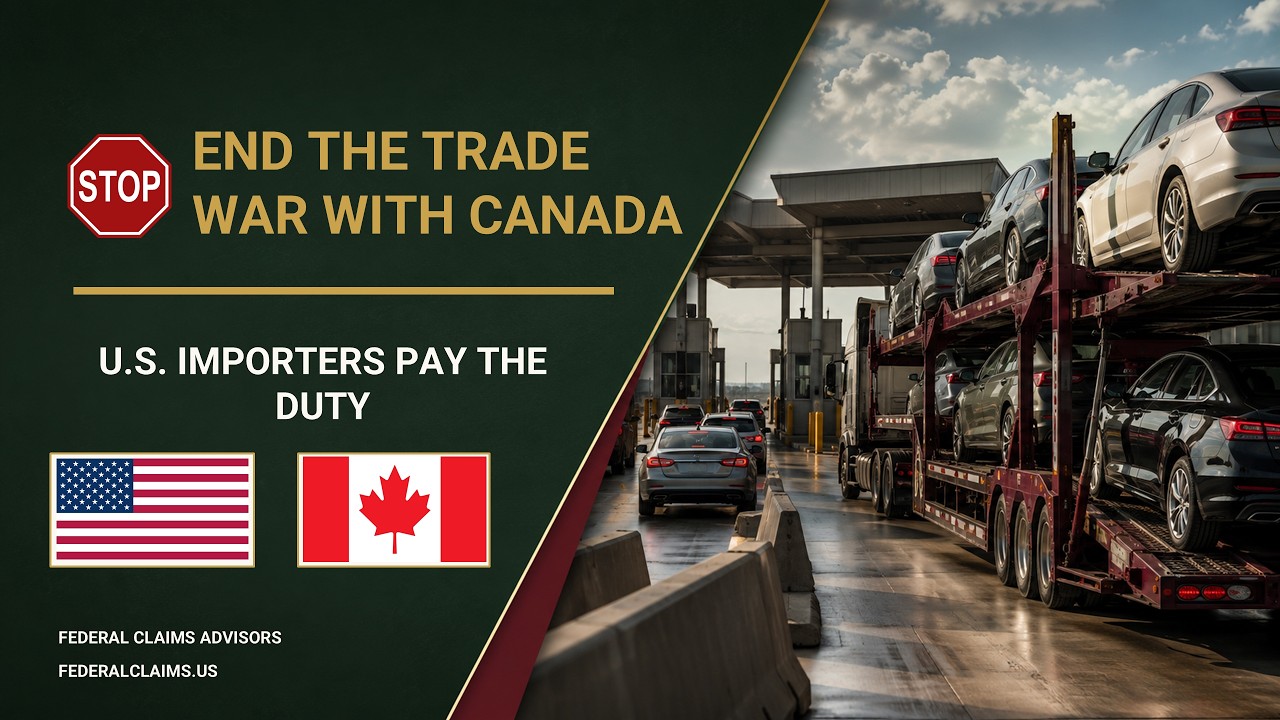
01:37First, the United States did not place a 50 percent tariff on every Canadian product. But three presidential proclamations have now created an additional 50 percent duty on hundreds of listed tariff categories. The Federal Reserve Bank of Chicago counted 569 eight-digit categories of imports that would be affected. Using May 2026 trade, it estimated that about 24 billion dollars in annual Canadian imports would be affected, roughly five and a half percent of all U.S. imports from Canada. The administration described the basket as nearly 20 billion dollars. The categories subject to the tariffs reach far beyond the labels on the proclamations. The alcohol action includes beer, wine, and spirits, but also some wooden packaging and hockey equipment. The dairy action includes milk powders and whey, but also molasses, hops, peppermint oil, and other preparations. The motor vehicle action carries most of the value. Its retaliatory list reaches agriculture, clothing, leather goods, art, jewelry, furniture, and sporting goods. And this matters: the tariff is not a bill mailed to Ottawa. U.S. Customs collects it from the importer of record in the United States. From there, the cost can become a lower margin, a canceled order, a demand for a lower Canadian price, a delayed investment, or a higher price for an American business or consumer. These tariffs become additional taxes paid on Canadian imports, and they diminish longstanding integrated relationships.
03:18 · The government's case
03:18The United States says Canada has discriminated against American commerce in three ways. First, most Canadian provinces and territories removed or restricted U.S. alcoholic beverages after the earlier tariff fight, while continuing to sell products from other countries. Second, the administration says Canada gave European cheese exporters more favorable access to dairy tariff-rate quotas than it gave U.S. exporters under the USMCA. Third, Canada imposed vehicle counter-tariffs and company-specific quota consequences in response to U.S. auto tariffs, while vehicles from other countries received different treatment. Those are the government's stated positions. The legal question is whether Congress authorized these tariffs as remedies within the scope of presidential authority and for these reasons.
04:09 · From emergency power to the 1930 Tariff Act
04:09The Constitution gives Congress the power to lay duties and regulate foreign commerce. Presidents impose tariffs only when Congress has delegated that power. In 2025, the administration relied on the International Emergency Economic Powers Act, IEEPA. On February 20th, 2026, the Supreme Court agreed that IEEPA does not authorize presidential tariffs. The Court emphasized that taxing imports is a distinct and extraordinary power, not something hidden inside the general authority to regulate importation. The administration then turned to tariffs under Section 122 of the Trade Act of 1974. Those officially expired on July 24th, 2026. Then Section 301 tariffs targeted alleged forced-labor enforcement failures. The August 22nd Canada tariffs rely on Section 338 of the Tariff Act of 1930. Unlike IEEPA, Section 338 allows duties of up to 50 percent after findings of discrimination and a public-interest determination. The duty must offset the burden. While the statute grants tariff power to the President, its modern boundaries remain largely untested. That makes this a somewhat different challenge, since Section 338 allows executive power under statutory limits. The legal boundaries of Section 338 have not been tested because no president had used it before as a form of strategic leverage in economic warfare.
05:51 · Questions a court may have to resolve
05:51Does Canada's conduct fit the form of discrimination described in this 1930 statute? Does a 50 percent duty on a broad basket offset the identified harm, or exceed it? Did Congress expect Section 338 power to require the International Trade Commission to investigate and make recommendations first? How does Section 338's imposition of duties interact with the USMCA? After the Supreme Court's IEEPA decision declared that Congress holds the power to impose tariffs, do these imposed duties now have to be narrowly construed? As of August 2026, with the imposition of the Section 338 tariffs, there is no court opinion deciding the legality of these new Section 338 measures. Here is the record we build as citizens for citizens, to stand and preserve our peace and prosperity and the future of our children. The future of all mankind depends on promoting and respecting fair trade, good faith, and honesty in fact.
06:55 · The USMCA did not disappear
06:55Another fact has been lost in the headlines. On July 1st, the United States declined to extend the USMCA in its current form. It did not automatically terminate the agreement. Article 34.7 says that when the parties do not all confirm an extension at the six-year review, they meet every year for the remainder of the term. The agreement continues toward 2036 unless the parties later extend it, the agreement expires, or a country separately withdraws on six months' notice. North America is now living through an unstable middle period. The treaty remains law, but its long-term political assurance has now been withheld.
07:39 · The economic recoil
07:39Canada is more exposed in this battle. Roughly three-quarters of its merchandise exports go to the United States. The Bank of Canada projects that U.S. trade restrictions would leave Canadian GDP about one and a half percent below its earlier projection by the end of 2026, with lasting effects on jobs, productivity, and living standards. But the United States is now standing inside the blast radius it has created. Canada was the top destination for U.S. exports in 2024. Bilateral goods and services trade reached an estimated 872 billion dollars in 2025. American factories buy Canadian inputs. American farmers and manufacturers sell into Canada. Retaliation closes markets in both directions. Federal Reserve research finds that tariff costs pass into consumer prices over time. They may protect selected producers, but they also raise input costs, redirect supply chains, reduce competition, and create uncertainty. Lower-income households generally bear a larger burden relative to income. Import duties, as a form of tariffs, can sometimes protect selected producers, but they also tax users of imported inputs, redirect supply chains, reduce competition, and create uncertainty.
09:08 · Why economic war is not just rhetoric
09:08The phrase becomes responsible when we define it as the use of maximum statutory tariff pressure to force policy change. These measures make trade more expensive for those affected, leaving a ruptured relationship for future generations to restore. Used as instruments of pressure, these tariffs target civilian trade in integrated American-Canadian industries. These tariffs are imposed amid worldwide instability, adding uncertainty to prices. The campaign is paired with threats, retaliation, industrial subsidies, purchasing boycotts, and efforts to redirect investment. And it is transforming political trust between two countries whose economies were deliberately built together. The United States calls the measures targeted enforcement against discrimination. Canada calls them an attack and economic coercion. The public should see both claims, then test the truth and the motives of the speakers. To be informed, read the statutes, the product lists, the trade data, and then figure out the cost of yet another disastrous war for no good reason. To see beyond the rhetoric and destruction of trust, look to the source of this antagonism and plan for the day the conflict passes.
10:26 · Closing statements — who decides, who pays?
10:26Trade disputes have always existed where there is trade. Trade disputes are best resolved in good faith. How nations build and sustain fair trade is not easily reduced to numbers. Who decides how a republic responds, and under what limits? And who bears the economic consequences of imposing these tariffs? Congress holds the constitutional tariff power. The President is invoking a 1930 delegation of authority that, under specified conditions, permits additional duties of up to 50 percent. The courts may be asked whether this use matches the text and structure Congress enacted. U.S. importers pay the duties at entry, while businesses and households may bear broader economic costs as that argument unfolds. Canadian goods will be sold elsewhere where they're fairly valued and appreciated. FederalClaims.us maintains a public library of legal authorities, tariff actions, court decisions, and economic evidence as this conflict unfolds. The escalation in economic war against Canada is a watershed. Our relationship has become the public and personal infrastructure for our lives. The citizens of both Canada and the United States stand firm against all needless wars. We build resilience with mutual respect and join together to push for peace and fair trade.
11:46 · Chronology
11:46This chronology separates earlier tariff conflicts from the present campaign. The 2018 steel and aluminum duties lasted approximately 12 months, while the 2020 Canadian aluminum measure lasted only 16 days. The IEEPA duties imposed in 2025 ended when the Supreme Court held that IEEPA did not authorize tariffs. Section 232 duties on metals, automobiles, and parts continue. The temporary Section 122 surcharge expired on July 24th after 150 days. The new Section 338 duties took effect on August 22nd, 2026. These measures should therefore not be treated as one continuous tariff.
12:32 · Three Section 338 proclamations
12:32The three Section 338 proclamations address different Canadian practices. Proclamation 11046 concerns alcoholic beverages. Proclamation 11047 concerns dairy market access and quota administration. Proclamation 11048 concerns motor vehicles. Each proclamation imposes an additional customs duty of up to 50 percent. The central legal question is whether each duty imposed in fact offsets the burden identified in the proclamation, or instead functions as a broader punitive tariff.
13:08 · Potential judicial review
13:08A challenge to Section 338 tariffs would likely begin in the United States Court of International Trade. A complaint and request for emergency relief could be filed within days or weeks. Preliminary injunction proceedings might require one to three months. Development of the administrative record and merits briefing could extend through the first year. Appeals to the Federal Circuit, and potentially the Supreme Court, could take two to three years or longer. The courts would separately examine the government's factual findings and the legal limits of the authority delegated by Congress.
13:43 · Tariff and customs-duty terminology
13:43Tariff and customs duty are related terms, but they describe different aspects of the measure. A tariff is the policy or legal schedule that establishes an import charge. A customs duty is the charge actually assessed on imported merchandise and collected from the importer of record. An additional duty is layered on top of the ordinary tariff schedule. An import surcharge is ordinarily temporary. Ad valorem means that the duty is calculated as a percentage of the merchandise's customs value. Canada commonly uses the word surtax for a retaliatory import charge.
14:20 · Primary authorities
14:20This briefing is grounded in the Constitution, Sections 122, 232, and 338 of the tariff laws, the three presidential proclamations, the Supreme Court's Learning Resources decision, rules of the Court of International Trade, and the USMCA. Direct links to these primary authorities are available through FederalClaims.us. The public should be able to examine the government's claim to authority, its factual findings, and the resulting costs of its proclamations.
Primary authorities and current government sources
Direct links; external sources open in a new tab.